

IOSH WORKING SAFELY:
IOSH Working Safely course is designed specifically to train employees from a wide range of backgrounds of the basic principles of health and safety in the workplace. The course covers the fundamentals of working safely especially the importance of individual responsibilities when it comes to workplace accidents
IOSH MANAGING SAFELY:
IOSH Managing Safely course is designed for non-health and safety personnel who have to manage risk and resources. It is also suitable for those with responsibility for health & safety. It is designed to provide an overview on health & safety based on risk-based approach to prevent accidents in the workplace.
IOSH Managing Safely
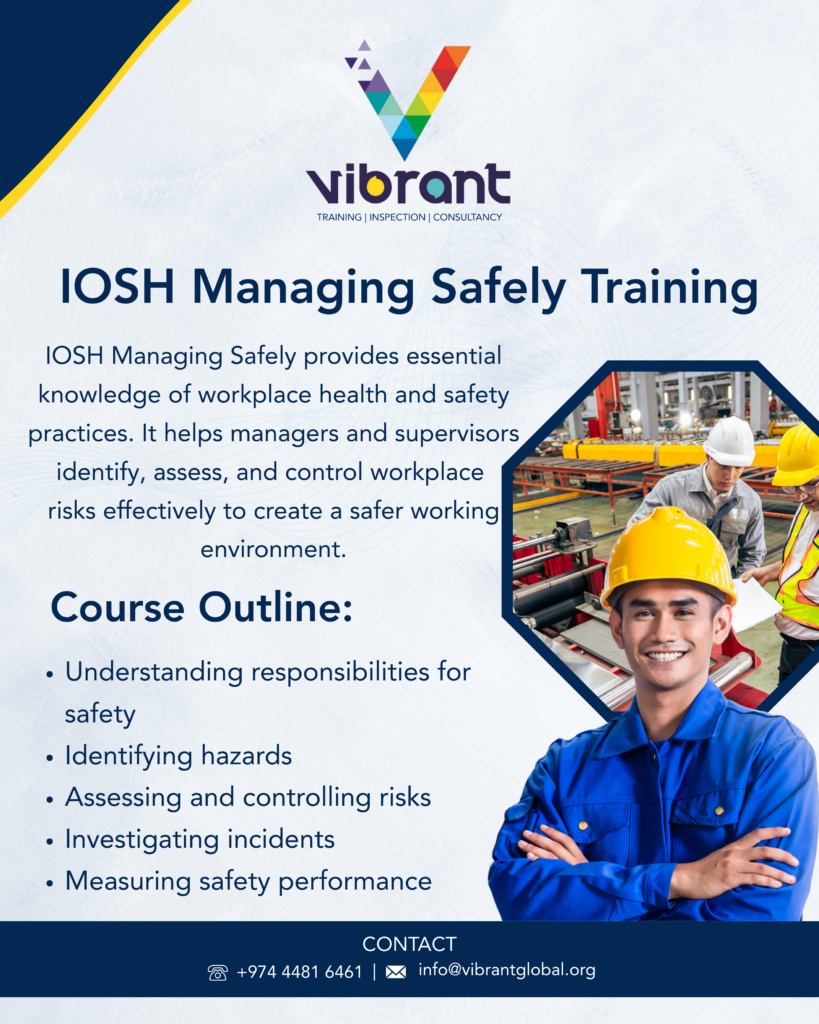
The IOSH Managing Safely course is designed for managers, supervisors, and team leaders who are responsible for overseeing people and workplace activities. It is particularly valuable for those who may not come from a health and safety background but still play a key role in ensuring that work is carried out safely. In many organizations, managers are the link between company policies and day-to-day operations, which makes their understanding of safety essential.
One of the strengths of this course is its practical and easy-to-understand approach. Rather than focusing heavily on technical jargon or complex theory, it explains health and safety in a way that makes sense in real working environments. Managers are guided on how to apply what they learn directly to their roles, making the training both relevant and useful from day one.
A core element of the course is hazard identification. Managers are trained to spot potential dangers in the workplace, whether they are obvious risks like machinery or more subtle issues such as poor housekeeping or unsafe behaviors. Recognizing these hazards early is the first step in preventing accidents and maintaining a safe environment for employees.
Closely linked to this is risk assessment. The course teaches managers how to evaluate risks by considering how likely an incident is to happen and how serious the consequences could be. This helps them prioritize actions and focus on the most critical issues first. By understanding risk properly, managers can take proactive steps to control it, rather than waiting for problems to arise.
Another important aspect covered in IOSH Managing Safely is the implementation of control measures. Once risks are identified, managers learn how to put effective solutions in place to reduce or eliminate those risks. This could involve introducing safer work procedures, providing appropriate personal protective equipment (PPE), or improving workplace conditions. The course emphasizes choosing practical and realistic controls that can be maintained over time.
The course also highlights the legal and moral responsibilities of managers. It explains that safety is not just about following rules but about protecting people from harm. Managers are made aware of their duty to ensure that employees, contractors, and visitors are not exposed to unnecessary risks. Understanding these responsibilities helps managers make informed decisions and reinforces the importance of safety in everyday operations.
Accident investigation is another key topic. When incidents occur, it is important not to simply address the immediate issue but to understand why it happened in the first place. The course teaches managers how to look deeper and identify root causes, such as poor training, lack of supervision, or ineffective procedures. By addressing these underlying issues, organizations can prevent similar incidents from happening again.
Monitoring and improving safety performance is also a major focus. Managers are shown how to carry out regular inspections, review safety practices, and ensure that control measures remain effective. This ongoing process helps maintain high safety standards and ensures that any new risks are identified and managed promptly. Continuous improvement is encouraged, making safety a dynamic and evolving part of the workplace.
Communication plays a vital role in successful safety management. The course encourages managers to engage with their teams, listen to concerns, and provide clear guidance. When employees feel comfortable speaking up about safety issues, it creates a more open and proactive environment. Managers are also encouraged to lead by example, as their behavior often sets the tone for the rest of the team.
Leadership is another important theme throughout the training. Strong leadership helps build a positive safety culture where everyone understands their role in maintaining a safe workplace. Managers who actively promote safety, recognize good practices, and address unsafe behavior contribute significantly to reducing risks and improving overall performance.
By completing the IOSH Managing Safely course, managers gain the confidence and practical knowledge needed to handle their safety responsibilities effectively. They are better equipped to identify hazards, assess risks, and implement suitable control measures. More importantly, they develop a mindset that prioritizes safety as an integral part of their role, not just an additional task.
Overall, the course supports organizations in creating safer workplaces by empowering managers with the right skills and understanding. When managers take ownership of safety, it leads to fewer accidents, improved employee well-being, and a stronger, more responsible working environment.